Is Your Office Helping or Hindering Your Team’s Productivity?
Your office environment can support concentration or compete for attention. Explore how noise, air quality, physical comfort and restorative spaces influence employee focus, and what businesses should consider when choosing a workspace.
Date:
October 9, 2026
Categories:
Is Your Office Helping or Hindering Your Team’s Productivity?
Your office environment can support concentration or compete for attention. Explore how noise, air quality, physical comfort and restorative spaces influence employee focus, and what businesses should consider when choosing a workspace.
Date:
October 9, 2026
Categories:
 Why Flexible Offices Make More Sense Than Traditional Leases in 2026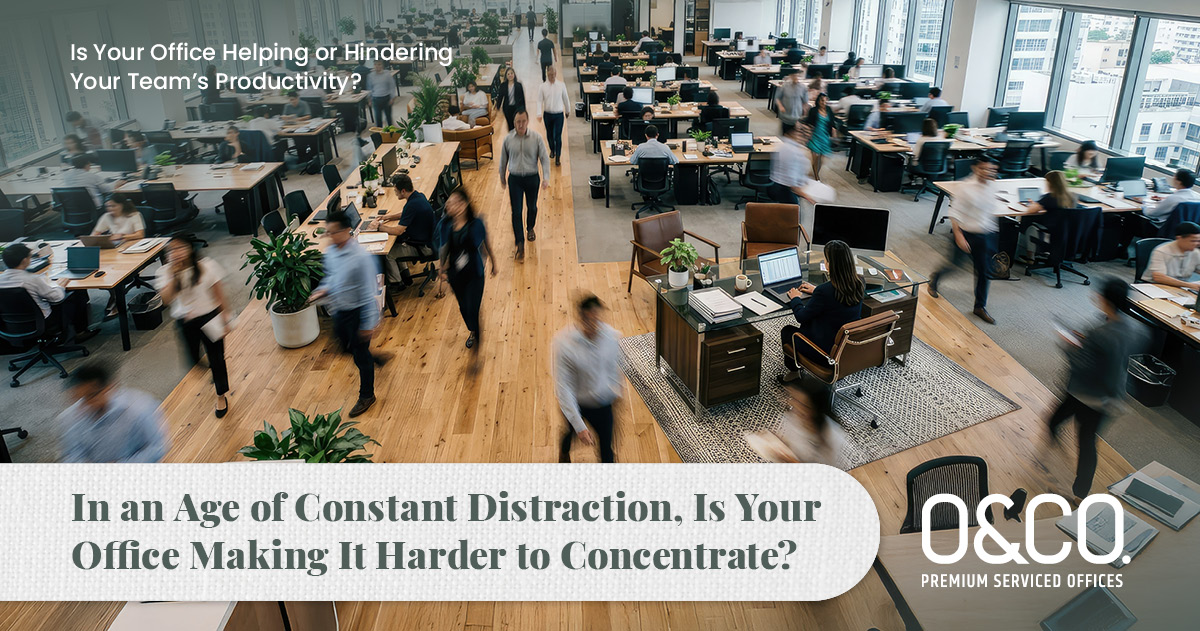
In an Age of Constant Distraction, Is Your Office Making It Harder to Concentrate?
There was a time when you could sit at your desk, open a document and reasonably expect to spend the next hour working on it. Today, you’ve barely finished your first sentence before an email arrives, someone needs a five-minute chat and your phone adds a final, cruel layer of pinging algorithmic distraction.
We’re working in an environment where almost everything competes for our attention. Digital platforms are designed to keep us engaged, workplace communication is increasingly immediate and AI is introducing more information, tools and decisions into the work day than ever before.
This all has significant consequences for our concentration.
Research by Dr Gloria Mark at the University of California, Irvine found that in 2004, people spent an average of around two and a half minutes on a computer screen before switching their attention elsewhere. By 2012, that figure had fallen to 75 seconds. More recent observations put it at just 47 seconds.
That doesn’t mean we’re incapable of concentrating for longer than 47 seconds. But it does tell us something about how frequently our attention moves between competing demands.
For businesses, this raises an interesting question. If sustained concentration is becoming harder to protect, are we doing enough to create office environments that support it?

The Cost of Distraction Isn’t Just Lost Time
An employee can spend an entire day responding to messages, attending meetings, checking information and switching between tasks, yet struggle to find an uninterrupted hour to work through a complicated problem.
They’re busy, in a buzzing-around sort of way, but how often are they doing their best work?
Mark’s research also highlights the mental effort involved in repeatedly redirecting our attention. Every switch requires us to reorient ourselves, remember what we were doing and pick up the thread again. Not exactly ideal conditions for your next big idea.
Whether you’re writing a proposal, developing a strategy, analysing financial information or solving a technical problem, you need to be able to hold information in mind and work through it without constant interruption.
And while technology has made many aspects of work faster, speed isn’t necessarily the same thing as quality.
AI adds an interesting dimension. It helps us summarise information, automate repetitive work and generate ideas, which can actually create more time for complex thinking. But that opportunity is only valuable if employees can make effective use of the time they gain.
There’s little benefit in removing one administrative task if the resulting space is immediately filled by another stream of interruptions.
Of course, not every distraction comes from a screen.
Sometimes, it’s the office itself.
When the Office Competes for Your Attention
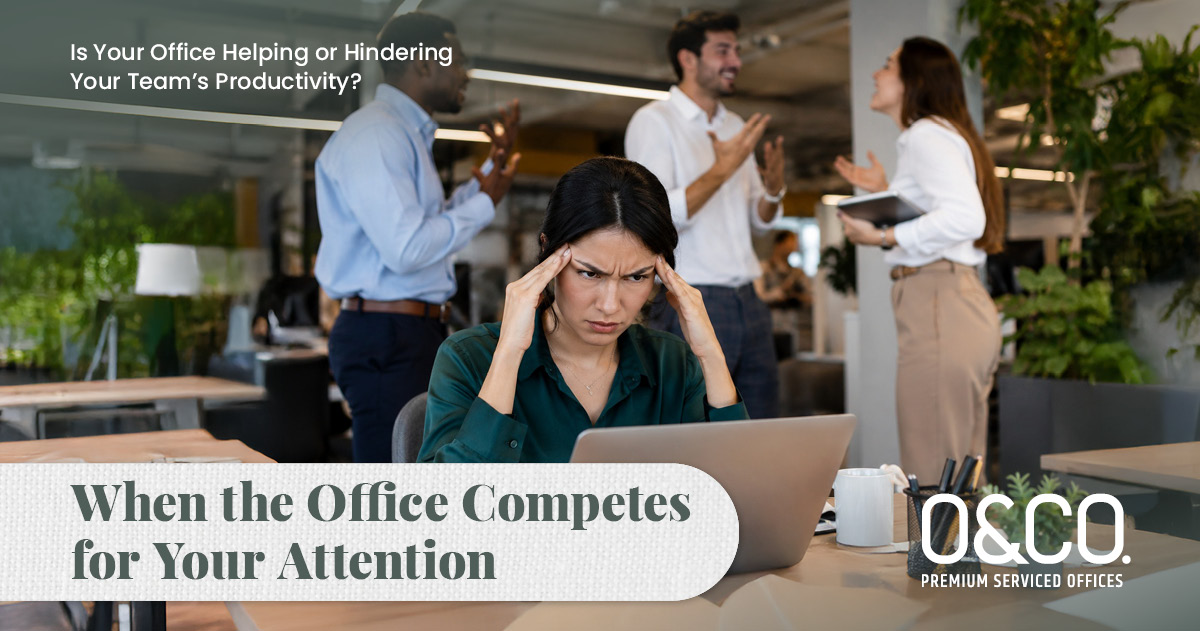
Consider the person trying to review a complicated contract while two colleagues discuss their weekend plans and complicated coffee orders a few desks away. Or the employee who has finally worked out how to approach a difficult piece of writing, only to lose their train of thought when another conversation starts nearby.
Background noise isn’t always harmless, particularly when it involves speech that our brains can understand and process.
Research into workplace acoustics has found that intelligible background speech can interfere with certain cognitive tasks, including proofreading accuracy. The effects vary depending on the task, which makes sense. Not all tasks need a totally silent office.
Conversation is essential to collaboration, and an office without any interaction would be a rather strange, sterile place to spend eight hours. The issue is whether your office allows people to concentrate when their work demands it, without constantly having to compete with everything happening around them.
Acoustic privacy, sensible spatial arrangements and access to quieter working areas can help reduce that competition.
But concentration isn’t only affected by what we hear. Temperature, lighting, air quality and physical comfort can also influence how well we’re able to think.
And some of the most interesting evidence comes from factors we’re often unaware of.

Sometimes It’s What’s in the Air
A beautifully furnished office might make an excellent first impression and give employees a place that, visually, they love being in. But the conditions that affect cognitive performance aren’t always the ones you can photograph.
Harvard University’s COGfx research programme investigated how indoor environmental quality influences cognitive function.
In one controlled study involving 24 participants, researchers compared cognitive performance under different conditions of ventilation and indoor air pollution.
The results, although on a pretty small sample, were striking. Average cognitive test scores were 61% higher under simulated green-building conditions and 101% higher under enhanced green-building conditions than under conventional conditions.
The largest differences appeared in higher-order cognitive functions such as strategy, information use and responding to complex situations.
This doesn’t mean installing a better ventilation system will suddenly double your team’s productivity. The study measured cognitive performance under specific experimental conditions, rather than everyday business output.
What it does demonstrate is that the physical environment can influence measurable aspects of thinking and decision-making.
That’s quite a compelling argument for looking beyond appearances when choosing an office for your team.
Natural light, ventilation, comfortable temperatures and a workspace that doesn’t continually demand physical adjustments might not attract the same attention as a spectacular reception area. But they’re worth considering for reasons that go beyond aesthetics.

A Little Space to Think Goes a Long Way
There’s another interesting side to environmental psychology: sometimes improving the conditions for concentration means giving people an opportunity to step away from concentrating.
We’re not designed to sustain intense mental effort indefinitely.
A 2023 systematic review by researchers at the University of Algarve examined 16 studies investigating exposure to natural elements in working environments. The researchers considered everything from outdoor green spaces and views of nature to indoor plants, natural sounds and simulated natural environments.
All 16 studies identified positive relationships between nature exposure and the restorative outcomes being investigated. These included reductions in stress and fatigue, improvements in wellbeing and, in some studies, benefits relating to cognitive or task performance.
The researchers were also careful to acknowledge the limitations of the evidence. Different studies measured different outcomes, and there isn’t a universal formula for how much exposure to nature is needed to produce a particular result.
Nevertheless, the findings suggest that natural elements and access to restorative environments can play a useful role in supporting employees during the working day.
Another randomised workplace study published in 2022 found that employees participating in a three-week programme of nature-based activities during working hours showed improvements in visual information-processing speed and selective attention compared with a control group, alongside reductions in measured stress indicators.
The intervention involved substantial periods of nature-based activity, so we can’t assume that looking at a plant for thirty seconds would produce the same results. But the broader implication is worth exploring.
A break from the desk doesn’t need to be a break from doing something valuable. Sometimes changing your surroundings or allowing your attention to settle elsewhere can help create the conditions for returning to a task with greater focus.
Perhaps that courtyard or outdoor seating area deserves a little more credit than simply being somewhere to eat lunch.
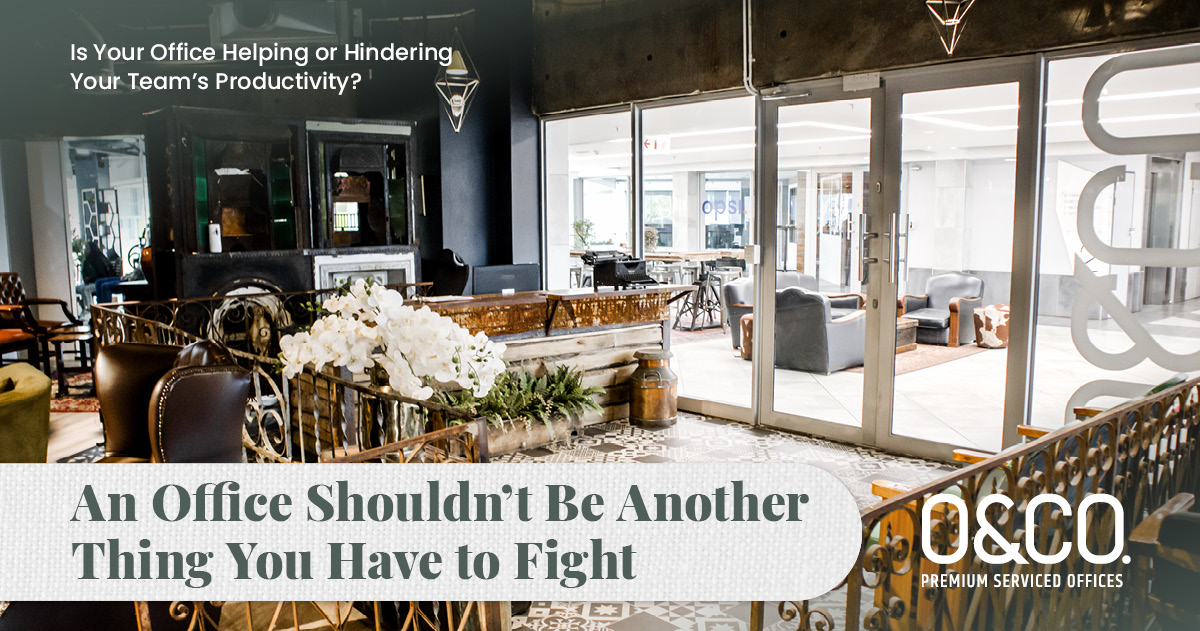
An Office Shouldn’t Be Another Thing You Have to Fight
Thoughtful office design can’t eliminate the distractions created by technology, poor meeting habits or a workplace culture that expects employees to respond to every message immediately. But it can help avoid adding unnecessary attention-depleting obstacles.
At Office & Co., we believe a workplace should offer more than a desk and an attractive address. Our spaces at Kyalami and Rosebank combine professional working environments with communal areas, thoughtfully furnished interiors and places where people can step away from their desks. At Kyalami, outdoor areas offer another opportunity for a change of scenery during the working day.
Good office design won’t eliminate every distraction or solve every productivity challenge. But it can remove some of the unnecessary obstacles, giving people a more comfortable environment in which to concentrate, think and do their work.
An office should make it easier to settle into a task, find a comfortable place to work and take a moment away when you need one. It shouldn’t constantly demand attention of its own.
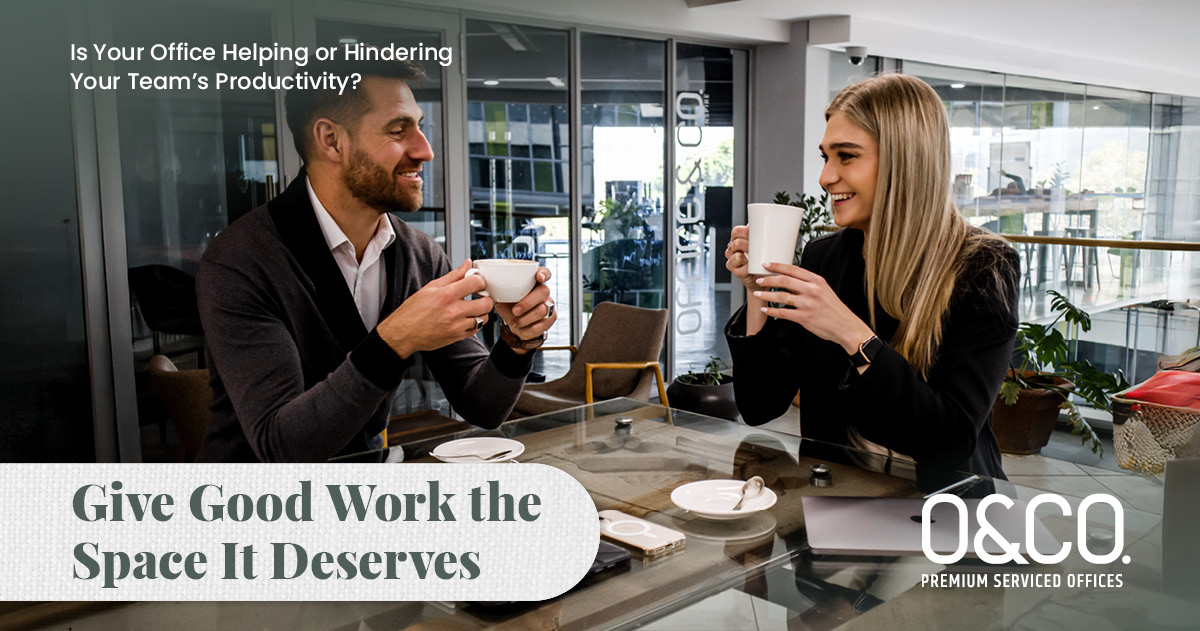
Give Good Work the Space It Deserves
Businesses invest considerable time and money in improving productivity. They introduce new technology, refine processes, measure performance and look for ways to help teams accomplish more (often involving some form of edible bribery).
Yet the physical workspace can remain surprisingly low on the list of considerations.
Maybe that’s because its influence is easy to overlook. You can measure the time spent in meetings or the number of tasks completed. It’s harder to measure the ideas that never quite developed because someone couldn’t concentrate, or the mistakes that might have been avoided in a less distracting environment.
Productivity isn’t only about how much work gets done. It’s also about the quality of attention available to do it well.
And a workplace that makes that attention harder to sustain is creating an obstacle your business may not even realise exists.
In a world where almost everything else is competing for our attention, perhaps one of the most valuable things an office can offer is the space to think.
Ready to Join Our Workspace Community?
If you’re looking for office space that offers flexibility, convenience, community, and modern business support tools, our client portal is part of what makes that experience different.
From meeting room bookings and equipment reservations to parking, networking events, and online canteen ordering, everything is designed to make your workday easier.